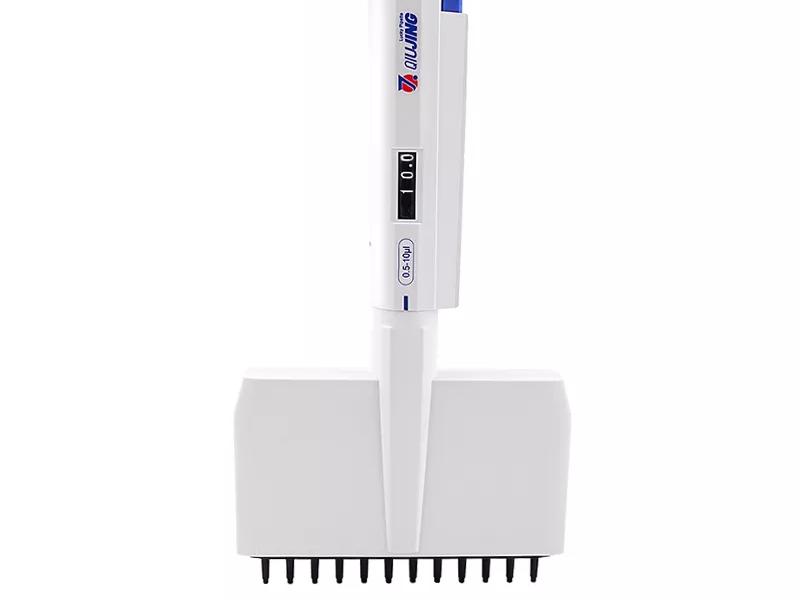
12-Channel Pipette: Core Guide
In high-throughput experiments such as PCR testing, ELISA assays, and cell screening, simultaneous pipetting of multiple samples is a daily task for laboratory personnel. The 12-Channel Pipette, with its core advantage of "multi-channel simultaneous operation", has become a key tool for improving experimental efficiency. This article comprehensively analyzes this laboratory "high-throughput assistant" from basic understanding to practical operation skills.
I. Basics: What is a 12-Channel Pipette?
Q1: What are the core differences between 12-channel and single-channel pipettes?
The core differences between the two focus on "processing efficiency" and "application scenarios", specifically reflected in three aspects:
1. Sample processing capacity: A single-channel pipette can only handle 1 sample at a time, while a 12-channel pipette can process 12 parallel samples simultaneously. For example, when pipetting into a 96-well plate, a 12-channel pipette only requires 8 operations to complete, whereas a single-channel one needs 96 operations;
2. Error control: The 12-channel pipette ensures highly consistent pipetting volumes across 12 channels through a unified piston drive system, avoiding parallel sample errors caused by changes in hand strength during repeated single-channel operations;
3. Application scenarios: Single-channel pipettes are suitable for small-batch, large-volume pipetting, while 12-channel pipettes are specifically designed for high-throughput carriers such as 96-well plates and 384-well plates, adapting to scenarios like PCR sample preparation and ELISA assay pipetting.
To quickly find a model that matches your laboratory's high-throughput needs, you can directly check the 12-Channel Pipette product details.
Q2: Is the "accuracy" of 12-channel pipettes reliable? Is it necessary for ordinary laboratories?
Its accuracy is guaranteed by double measures, fully meeting the needs of routine experiments: First, it adopts 12 sets of independent precision pistons, combined with anti-leakage sealing technology, and the pipetting error can be controlled within ±1.5% (when the volume range is ≤100μL); Second, most models support fine-tuning of the volume range, for example, based on the standard 50μL pipetting, it can be accurately adjusted to 48μL to adapt to special reagent requirements.
Whether it is necessary to equip depends on the experimental scenario: If the laboratory often conducts parallel sample testing (such as viral nucleic acid screening in CDCs),high-throughput drug screening, or pipetting supporting microplate readers, the 12-channel pipette can reduce the pipetting time by more than 80% and reduce human errors in parallel samples, making it an essential tool; If only occasional sample processing is needed, a single-channel pipette is sufficient.
II. Scenario Analysis: What Pain Points Can 12-Channel Pipettes Solve?
Q3: What is its core role in PCR experiments in molecular biology laboratories?
The key in PCR experiments is the "fast and uniform distribution of sample templates and reagents", and the 12-channel pipette directly addresses two major pain points:
1. Efficient pipetting: When preparing the reaction system in a 96-well PCR plate, 20μL of enzyme mixture needs to be added to each well. A single-channel pipette requires 96 repeated operations, taking 15 minutes and being prone to missing and wrong pipetting; A 12-channel pipette can complete the task in 3 minutes with only 8 operations, and can avoid well position confusion through color-marked channels;
2. Uniform system: PCR reactions are sensitive to system concentration. The 12-channel pipette aspirates and dispenses liquid simultaneously, ensuring that the concentrations of enzymes and primers in 12 parallel samples are completely consistent, avoiding differences in amplification curves caused by uneven pipetting.
Exclusive adaptation plans for PCR experiments can be obtained on the 12-Channel Pipette product page.
Q4: How does the 12-channel pipette improve experimental reliability in immunological ELISA assays?
The core of ELISA assays lies in "serial dilution" and "signal uniformity", and the 12-channel pipette has advantages in two aspects:
1. Efficient serial dilution: When the standard needs to be serially diluted from 1:10 to 1:10000, the 12-channel pipette can process 12 dilution gradients simultaneously, avoiding the risk of "previous sample contaminating the next one" in single-channel operations;
2. Uniform incubation signal: After pipetting, the reaction environment of the sample in the microplate well needs to be consistent. The 12-channel pipette ensures the same liquid volume in each well, avoiding deviations in absorbance values caused by volume differences, making the experimental results more convincing.
Q5: Is it feasible to use a 12-channel pipette to handle cells in 96-well plates during cell culture?
It is completely feasible, and it can solve the problem of "uniform seeding density" in cell culture. For example, when conducting cell proliferation experiments in a 96-well plate, 100μL of cell suspension containing 5000 cells needs to be seeded into each well: Single-channel operation is prone to uneven cell density in some wells due to hand tremors; The 12-channel pipette can complete the seeding of 12 wells simultaneously, ensuring the same number of cells in each well and avoiding the impact of "inter-well differences" on result analysis in subsequent experiments. In addition, when used with sterile tips, it can also prevent cross-contamination of cells.
III. Operation & Maintenance: Easy to Master for Beginners
Q6: Is the 12-channel pipette complicated to operate? What should beginners pay attention to?
The operation logic is similar to that of a single-channel pipette, and beginners can master the core steps in 5 minutes. The key points to note are two aspects:
1. Three basic operation steps: ① Select the tip: Choose a suitable 12-connected tip according to the volume range, align it with the interface and press vertically to install, ensuring no looseness; ② Set the volume range: Rotate the volume adjustment knob to adjust the volume to the target value (e.g., 50μL), and be careful not to exceed the upper limit of the volume range; ③ Aspirate and dispense: Press the operation button to the first stop to aspirate, stay for 1 second, then move to the target well, and press to the second stop to complete dispensing;
2. Key precautions: Keep the pipette vertical when aspirating to avoid uneven liquid aspiration in each channel due to inclination; Stay for 2 seconds after dispensing before moving away to prevent liquid residue.
For a more intuitive operation demonstration, you can watch the video on the 12-Channel Pipette product page.
Q7: How to perform daily maintenance to extend the instrument's service life?
Do a good job in 4 maintenance points, and the service life of the instrument can be extended to more than 5 years:
1. Timely cleaning: Wipe the pipette body with alcohol swabs after each use. If contaminated by viscous liquids such as cell suspension and serum, wipe it with sterile water before disinfection to prevent liquid from seeping into the interior and corroding components;
2. Regular calibration: Calibrate once every 3 months. A dedicated calibrator can be used, or the manufacturer can be contacted for on-site calibration to ensure consistent pipetting accuracy across 12 channels;
3. Standard tip usage: Avoid excessive force when installing the tip. Use the tip ejector to remove the tip, and do not pull it directly with your hands;
4. Storage points: Place it on a dedicated stand, keep it horizontal, avoid direct sunlight and humid environments. When not in use for a long time, adjust the volume range to the maximum to protect the spring.
IV. Selection Tips: Choose the Right Model Without Mistakes
Q8: How to choose 12-channel pipettes of different volume ranges and types?
Follow the principle of "volume range matching + scenario adaptation", and choose the right model in 3 steps:
1. Determine the volume range: Choose according to the commonly used pipetting volume. Small volume range (0.5-10μL) is suitable for PCR template pipetting, medium volume range (10-100μL) is suitable for ELISA reagent pipetting, and large volume range (100-1000μL) is suitable for cell suspension seeding;
2. Consider the type: Manual models are suitable for small to medium-batch experiments; electric models are equipped with dedicated aspirating and dispensing buttons, no manual pressing is required, which is suitable for high-intensity scenarios where pipetting takes more than 2 hours a day, and can also reduce hand strain;
3. Check details: Prioritize models with "anti-dripping design" and "volume lock". The anti-dripping function can prevent liquid from contaminating the pipette body, and the volume lock can prevent volume deviation caused by accidental touches.
Not sure which model is suitable for your laboratory? You can submit your experimental needs on the product page to get exclusive recommendations.
V. Summary: Core Value of 12-Channel Pipette
The core value of the 12-channel pipette lies in converting "repetitive work" in high-throughput experiments into "efficient and accurate operations"—it not only greatly improves pipetting efficiency but also ensures the reliability of experimental results by reducing human intervention. It is a "standard tool" in laboratories in fields such as molecular biology, immunology, and cell biology.
To learn more about specific model parameters, operation skills, or procurement plans, please click the 12-Channel Pipette product page to obtain more professional information.
Disclaimer: This website respects intellectual property rights. If any infringement is found, please contact this website in a timely manner for handling
December 13, 2025
822
 EN
EN RU
RU


 Industry News
 How Should Global Buyers Evaluate Chinese Manufacturers?

 Current Affairs







 IPv6 network supported