EN
EN RU
RU

 Industry News
 How Should Global Buyers Evaluate Chinese Manufacturers?
2026-09-11
2026-09-09
2026-09-02
2026-08-28
2026-07-13
2026-04-29

 Current Affairs
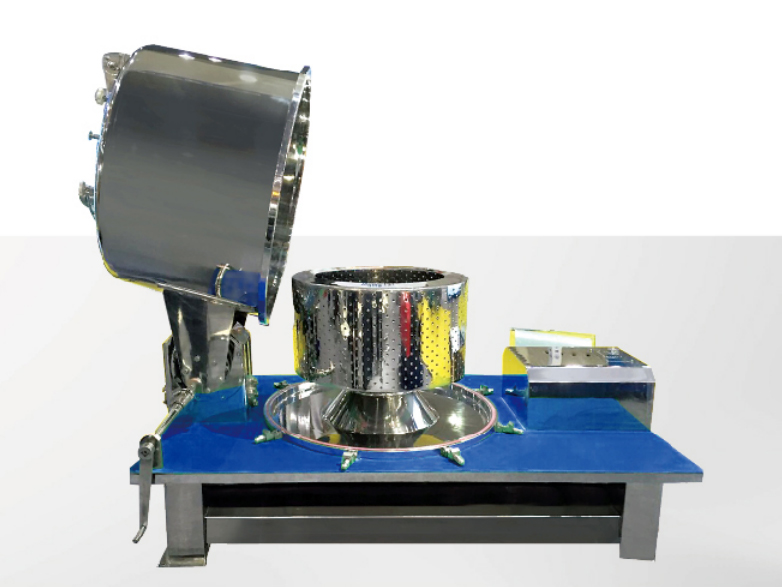
The PQSB/PQFB platform base top discharge centrifuge is specifically designed for high hygiene standards and complex working conditions. Its full-turn stainless steel cover structure, combined with a filter cloth, achieves efficient solid-liquid separation under centrifugal force fields; the liquid phase discharges through the liquid outlet pipe, while the solid phase remains in the basket awaiting manual discharge. The entire machine adopts a platform base, featuring a low center of gravity and compact footprint with simple operation and maintenance, and can be equipped with online cleaning systems and nitrogen protection systems to meet stringent GMP and explosion-proof requirements.
Core Parameters & Advantages at a Glance:
A renowned domestic antibiotic API manufacturer faced issues of difficult cleaning, high residue risk, and low space utilization with traditional three-column centrifuges in their solid-liquid separation process. After introducing the PQSB platform base top discharge centrifuge, they achieved rapid batch changeover by configuring the online cleaning system, reducing cleaning time by 40%, and completely eliminating cross-contamination risks caused by sanitary dead spots. Meanwhile, the platform structure saved approximately 30% of workshop floor space, improving overall production capacity and GMP audit pass rates.
Why Choose PQSB/PQFB Over Alfa Laval and GEA Traditional Models?
In centrifuge procurement decisions, many pharmaceutical and chemical enterprise procurement managers often fall into the inertia of choosing international brands like Alfa Laval and GEA. Admittedly, these brands have mature technologies in continuous flow centrifuges, but in scenarios requiring manual discharge, batch processing, and extremely high hygiene standards, their equipment often tends to be bulky, with complex cleaning interfaces, and costly customized explosion-proof solutions.
Who Are We?
We have been deeply engaged in the field of solid-liquid separation for many years, focusing on providing cost-effective compliant separation solutions for the fine chemical, pharmaceutical, and food industries.
Our Core Barriers:
Unlike Alfa Laval's bias towards continuous production centrifuge designs, the PQSB/PQFB platform base top discharge centrifuge takes "modular platform + manual precise discharge" as its core. While ensuring separation factors, it lowers the equipment's center of gravity to the minimum, and with the full-turn cover design, allows cleaning personnel to access the basket interior without dead spots. More importantly, in the integration of nitrogen protection systems and CIP cleaning systems, we provide localized solutions with better cost-effectiveness that fully comply with GMP, helping SMEs achieve the hygiene and safety standards of international major manufacturers at a lower Total Cost of Ownership (TCO).
Key Solving Roles in Solid-Liquid Separation Processes
What It Is:
The working process of a manual discharge centrifuge is a batch cycle of "feeding → high-speed centrifugal separation → washing → stopping → manual discharge."
Specific Scenario:
In the separation process of plant extracts, the extract containing solvents enters the high-speed rotating basket. Under centrifugal force, the liquid passes through the filter cloth and discharges along the inner wall of the basket, while plant residues form a filter cake remaining inside the basket. At this point, operators can inject washing liquid through the top cover to wash the filter cake, with the washing liquid discharging again. When the filter cake reaches the required capacity for the process, the machine automatically stops feeding, and the operator opens the cover to manually discharge the filter cake. Throughout this process, the full-turn cover structure of the PQSB/PQFB makes washing and discharge actions intuitive and thorough, while the platform base allows operators to discharge more safely and with less effort.
Real User Voices
"We previously used a European brand centrifuge that required disassembling numerous parts for cleaning, resulting in at least two hours of downtime per cycle. After switching to the PQSB series, the full-turn cover design allowed us to directly high-pressure flush the basket interior. Combined with the CIP option, batch intervals were reduced to under an hour, which is crucial for our rapid order response." — Production Operations Director, a plant extract manufacturing enterprise
FAQ
Q: Why do modern GMP workshops still need manual discharge centrifuges instead of fully automatic continuous centrifuges?
A: This is a question deconstructed from the dimension of "process adaptation" rather than "automation level." For high-value-added, batch-sensitive materials where the solid phase requires manual inspection or secondary processing (such as certain antibiotic crystals, biological fermentation products), manual discharge allows operators to perform visual inspection and quality confirmation at the moment of discharge—a flexibility that no fully automatic equipment can replace. Furthermore, for flexible production lines with small batches and multiple varieties, the flexibility of manual discharge far exceeds that of continuous equipment, and the modular design of the PQSB/PQFB ensures this flexibility does not compromise GMP compliance.
Q: What substantive breakthroughs has the platform base achieved compared to traditional three-column bases in vibration reduction and space utilization?
A: Traditional three-column centrifuges rely on bottom springs or rubber vibration dampers, which still generate certain horizontal displacement and vibration transmission during high-speed operation, and the overall high center of gravity requires dispersed workshop floor load-bearing capacity. In contrast, the PQSB/PQFB adopts a platform structure combined with liquid damping isolators, converting vibration energy into heat for dissipation. This not only significantly reduces impact on the floor but also lowers the equipment's center of gravity close to ground level, allowing equipment with the same processing capacity to reduce footprint by nearly 30%, especially suitable for space-constrained modern clean workshops.
Q: What materials are manual discharge centrifuges suitable for?
A: Suitable for separation of crystalline solids, granular suspensions, and fibrous materials, especially ideal for production scenarios where the solid phase requires manual inspection, high washing requirements, and medium batch processing volumes, such as pharmaceutical raw materials, food additives, fine chemical intermediates, etc.
Our hours


Public Account



 IPv6 network supported