EN
EN RU
RU

 Industry News
 How Should Global Buyers Evaluate Chinese Manufacturers?
2026-09-11
2026-09-09
2026-09-02
2026-08-28
2026-07-13
2026-04-29

 Current Affairs
Q1.What Is a Single Channel Pipette?
A Single Channel Pipette is a handheld device designed to aspirate and dispense small, precise volumes of liquid. It dispenses liquid through one channel, making it ideal for individual tubes, vials, and microplates. For users seeking stable and comfortable pipetting performance in routine work, modern ergonomic designs such as the [Lucky Series Single Channel Pipette] are often used to improve accuracy during daily tasks.
Single-channel models are best for sample preparation, reagent addition, dilutions, and tasks that require high precision but not large batch processing.
These pipettes typically range from as low as 0.1 μL up to 10 mL, depending on the design and laboratory needs. They offer precision, wide applicability, ergonomic handling, and consistency, making them a fundamental tool across countless workflows.
Q2.How Does a Single Channel Pipette Work?
The device functions based on an air-displacement or positive-displacement system. Pressing the plunger creates air movement, drawing liquid into the disposable tip.
The first stop aspirates the liquid; the second stop dispenses it completely. Pipette tips attach to the lower end and vary by brand compatibility.
Air-displacement pipettes are used for aqueous solutions, while positive-displacement pipettes are used for viscous, volatile, or dense liquids.
Temperature, tip quality, user technique, and pipette calibration all affect measurement accuracy and reproducibility.
Types of Single Channel Pipettes
Ergonomic pipettes—such as the balanced and lightweight [Lucky Series Single Channel Pipette]—reduce strain during long usage.

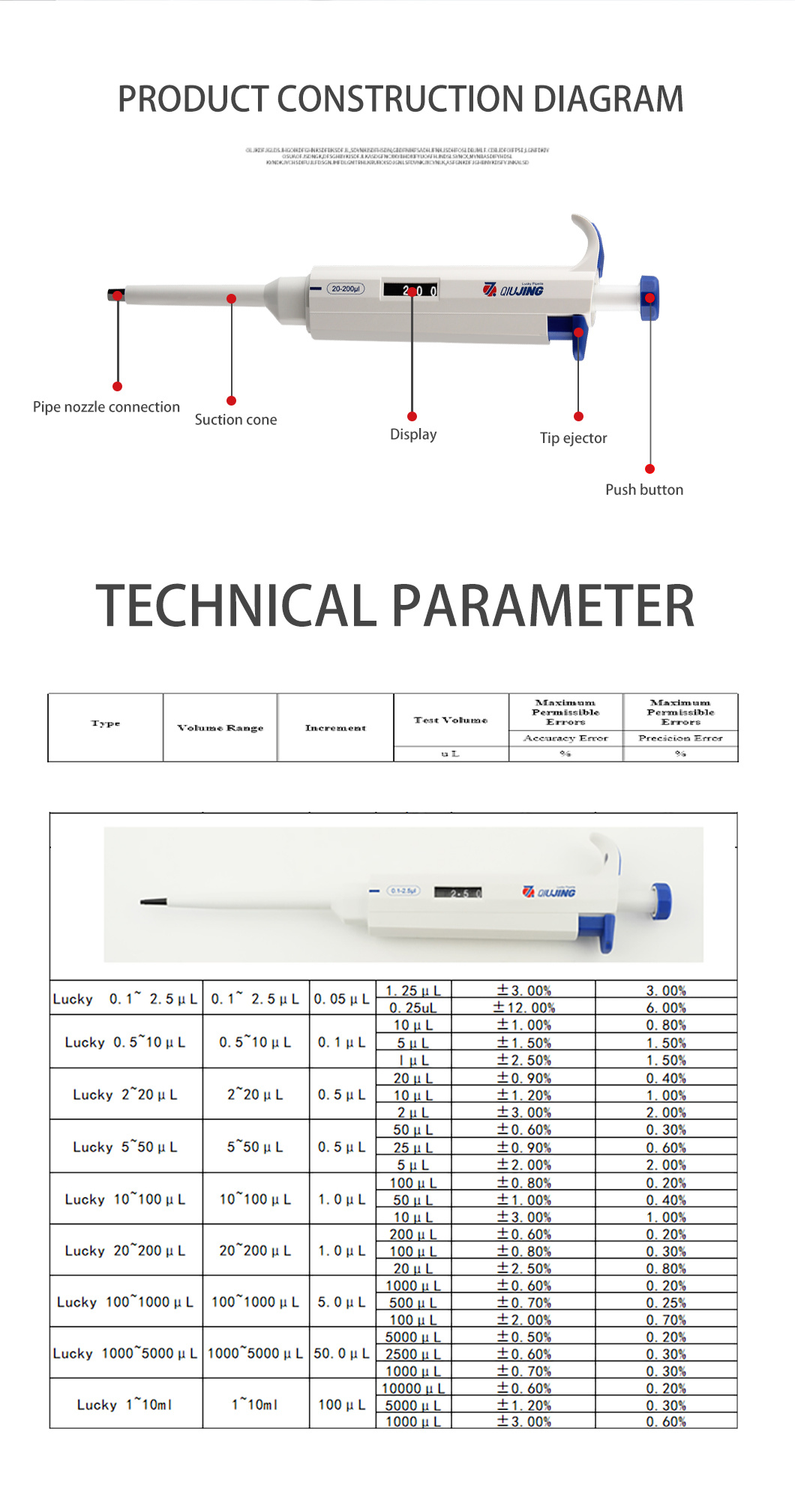
Specialized micropipettes (e.g., 0.1–2 µL) support sensitive applications like PCR.
Key Features to Consider Before Buying
Q3.How to Choose the Right Single Channel Pipette
Different laboratory types require different volume ranges.
Examples:
• 0.1–2 µL for PCR
• 20–200 µL for ELISA
• 100–1000 µL for reagent preparation
Comparing models involves considering weight, calibration intervals, plunger feel, and tip compatibility. Many users also evaluate long-term comfort—an area where pipettes like the [Lucky Series Single Channel Pipette] are optimized for repetitive daily use.
Q4.How to Use a Single Channel Pipette Correctly
Set the desired volume, attach the tip, aspirate at the first stop, dispense at the second stop.
Keep the pipette vertical, pipette slowly, avoid touching tube walls, and minimize immersion depth.
To improve accuracy, pre-rinse tips, keep temperatures stable, and handle liquids gently.
Use filter tips to prevent contamination and low-retention tips to reduce sample loss.
Q5.How to Calibrate and Maintain a Single Channel Pipette
Signs it needs calibration include inconsistent volumes, dripping tips, or resistance in the plunger.
Calibration involves weighing dispensed water using an analytical balance and comparing with expected values.
Clean external parts with 70% ethanol and follow manufacturer guidelines for internal cleaning. Replace O-rings, seals, and pistons as needed. Store pipettes vertically to prevent liquid damage.
Troubleshooting Common Pipette Problems
Single Channel Pipette Applications
Best Practices for Efficient Pipetting
Temperature control, tip pre-rinsing, ergonomic pipettes, upright storage.
FAQ
• You need multiple pipettes for different ranges.
• Calibrate every 6–12 months.
• Dripping usually means worn seals or incompatible tips.
• Single-channel is enough for small-scale work; multi-channel for high-throughput tasks.
Glossary
Related Products
Pipette tips, multi-channel pipettes, electronic pipettes, pipette stands, balances, calibration tools.
Conclusion
Single Channel Pipettes are essential for precise liquid handling across scientific workflows. Understanding their function, selecting the right model, and following proper techniques help ensure accuracy and reliability. Choosing ergonomic, stable-performing equipment—such as the [Lucky Series Single Channel Pipette]—further enhances consistency and user comfort in everyday laboratory operations.


Disclaimer: This website respects intellectual property rights. If any infringement is found, please contact this website in a timely manner for handling.
Our hours


Public Account



 IPv6 network supported